Though the Chicago's teacher's strike has tentatively come to an end, getting the issues fairly addressed in the media as been a struggle. Here is what they are fighting for int he words of a Chicago teacher. Please pass it on.
"...the mainstream media is not covering all of the issues for which the teachers are striking. It is unsettling, but that is where we come in. It is our job to talk with friends, colleagues, and neighbors to illuminate the struggles that the students face in Chicago. A school with 1000 students does not have a social worker. Teachers use economic text books that are 12 years old. Our curriculum has become more and more narrowed to teach finite skills on absurdly written tests, tests which close our neighborhood schools and unfairly evaluate us. In CPS once test scores drop, the district begins to divest in the school and take away parent, teacher, and administrative voice, leaving the schools left to improve with fewer resources..."
If we care about children, we can do better. Detractors paint teachers as selfish money-grubbers who work few hours for high pay. That is not the issue.
The issues are:
Do we really want to assess teachers based on student test scores? Not only has this been repeatedly proven to be unreliable, it means that students will have to sit for tests--all the time.
Try to imagine being a student who must take multiple tests in every grade. Now try to imagine how teachers and systems might try to ensure that all students are read to take the tests. Right. More tests to make sure they are ready for THE test. (This is already the way many students experience school right now.) Now, try to imagine how an adult, who's livelihood depends on the test scores, might behave. Getting a little ugly, isn't it?
Who, in this fight, is really thinking about the children?
Why is there NO money for air-conditioning or new texts but there IS money for charter schools and multiple tests? (Both of which have been proven to have very poor track records for improving education.)
Who, in this fight, is really thinking about children?
Why is poverty an EXCUSE for teachers but not for public officials? Children make up the majority of those who live in poverty, but that's okay?
Who, in this fight, is thinking about children?
Saturday, September 15, 2012

Monday, September 3, 2012
Feeding the Data Machine
In 1978 when I began teaching, I was handed a plan book, grade book, curriculum map, test book, and a schedule.
Off to work I went, writing things down, assessing kids all by myself, and reporting grades. (To be honest, I can't remember how we did this! Were high school report cards hand written?)
Today, all teachers must be conversant with a wide variety of software: grading software (that keeps parents continually updated), a student-accessible website (that must be continually updated), and a large variety of behind the scenes software responsible for collecting data (that ultimately must be kept 'fed' by the classroom teacher). All of these duties take more time than the old-fashioned method. (But if its in a computer then it must be true!)
Every school year, each program must be updated with the current rosters. This year we are adding individual online student accounts to access the textbook - as I'm sure is occurring all over the nation as textbooks gain an online presence.
This takes considerable time and often results in a mad scramble at the beginning of the year as kids are put into the system, taken out, moved around, and on and on. Yesterday, (Sunday of Labor Day) I spent five hours in service to some of these tools. I will spend more time updating the course website later today. (Computers: So convenient you can continue to work from home!)
Sometimes things go awry. We are not a Fortune 500 corporation with legions of data crunchers and IT specialists. In public schooling it is every district for itself when it comes to meeting the data-driven demands in terms of salaries and techy tools. Each year these tools take up more and more of the budget pie.
But the data machine must be fed, and it is getting worse rather than better. The reformist love affair with numbers means that nothing is real unless it is quantifiable with a number.
The classroom teacher provides all the raw data.
And so, just like the day I realized I was working for the machines in my life -- car, household appliances--rather than the other way around, I find myself increasingly chained to a computer. (Thoreau: We do not ride on the railroad. It rides upon us.)
And it's not helping.
Recently, in an effort to get our struggling students some additional help as soon as possible, rather than waiting on the official data, we asked teachers to look at their previous year's rosters, highlight the names of kids who could benefit from some enriching activities, and send the lists on.
It took about ten minutes.
That's what can happen when you rely on professional judgement.
Still waiting on the "data."
Sometimes it feels like we're spinning our wheels.
Off to work I went, writing things down, assessing kids all by myself, and reporting grades. (To be honest, I can't remember how we did this! Were high school report cards hand written?)
Today, all teachers must be conversant with a wide variety of software: grading software (that keeps parents continually updated), a student-accessible website (that must be continually updated), and a large variety of behind the scenes software responsible for collecting data (that ultimately must be kept 'fed' by the classroom teacher). All of these duties take more time than the old-fashioned method. (But if its in a computer then it must be true!)
Every school year, each program must be updated with the current rosters. This year we are adding individual online student accounts to access the textbook - as I'm sure is occurring all over the nation as textbooks gain an online presence.
This takes considerable time and often results in a mad scramble at the beginning of the year as kids are put into the system, taken out, moved around, and on and on. Yesterday, (Sunday of Labor Day) I spent five hours in service to some of these tools. I will spend more time updating the course website later today. (Computers: So convenient you can continue to work from home!)
Sometimes things go awry. We are not a Fortune 500 corporation with legions of data crunchers and IT specialists. In public schooling it is every district for itself when it comes to meeting the data-driven demands in terms of salaries and techy tools. Each year these tools take up more and more of the budget pie.
But the data machine must be fed, and it is getting worse rather than better. The reformist love affair with numbers means that nothing is real unless it is quantifiable with a number.
The classroom teacher provides all the raw data.
And so, just like the day I realized I was working for the machines in my life -- car, household appliances--rather than the other way around, I find myself increasingly chained to a computer. (Thoreau: We do not ride on the railroad. It rides upon us.)
And it's not helping.
Recently, in an effort to get our struggling students some additional help as soon as possible, rather than waiting on the official data, we asked teachers to look at their previous year's rosters, highlight the names of kids who could benefit from some enriching activities, and send the lists on.
It took about ten minutes.
That's what can happen when you rely on professional judgement.
Still waiting on the "data."
Sometimes it feels like we're spinning our wheels.
Tuesday, August 14, 2012
Shift the culture for lasting change
Those who follow this blog already know of my great respect for the model that is the National Writing Project. The work done through this network of educators has been frequently referred to as professional development that works in that it affects a lasting change in teacher practice over time.
This summer, in a short presentation on working with professionals across a generational divide (four generations, the largest cross-generational grouping, now work side by side) I was exposed to the simple graphic below as an explanation for why certain generational groups approach their work differently.
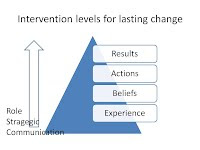
It immediately resonated as a model for the failure of most of the professional development in schools to affect a lasting change.
It also offers a strong argument for why the Intensive Summer Institute, and the ensuing network of teaching professionals, has proven to impact student learning.
The chart maintains that experiences affect our beliefs. Those beliefs influence our actions which ultimately determines results.
Most professional development only acts on the top two tiers. "Do intervention a, b, or c and you will get prescribed results." The intervention does not 'take' because nothing has been experienced which will change beliefs. Without ongoing support for new strategies, the teacher does not have enough experience to change beliefs and falls back on old assumptions. When the first initiative fails, a new approach is introduced.
The experience of most teachers has built the belief that "this too shall pass." We need only wait out the current reform as another one will surely replace it.
Conversely, the teachers of the Invitational Summer Institute are immersed in experiences which affect their beliefs about practice. They apply theory to practice, experience heightened engagement from learning from each other, examine student work across time and curriculum, and, most importantly in understanding how writing happens, write with an eye toward publication for a valued audience. Over the period of a month or more, teacher create a collaborative, respectful learning environment of sharing practice, theory, and the writing life.
It is these combined experiences that teachers most often describe as 'transformational.' The combined experience of the Institute leads teachers to the belief that their work is worthy of study, reflection, and revision--and that they can take charge of these habits of mind.
If we are to believe the model pictured in the graphic, the culture of the teaching profession must change. Changing the experience of teachers from one of subservience to empowerment will result in classroom teachers who can enact substantive and lasting reform on a classroom by classroom basis.
This summer, in a short presentation on working with professionals across a generational divide (four generations, the largest cross-generational grouping, now work side by side) I was exposed to the simple graphic below as an explanation for why certain generational groups approach their work differently.

It immediately resonated as a model for the failure of most of the professional development in schools to affect a lasting change.
It also offers a strong argument for why the Intensive Summer Institute, and the ensuing network of teaching professionals, has proven to impact student learning.
The chart maintains that experiences affect our beliefs. Those beliefs influence our actions which ultimately determines results.
Most professional development only acts on the top two tiers. "Do intervention a, b, or c and you will get prescribed results." The intervention does not 'take' because nothing has been experienced which will change beliefs. Without ongoing support for new strategies, the teacher does not have enough experience to change beliefs and falls back on old assumptions. When the first initiative fails, a new approach is introduced.
The experience of most teachers has built the belief that "this too shall pass." We need only wait out the current reform as another one will surely replace it.
Conversely, the teachers of the Invitational Summer Institute are immersed in experiences which affect their beliefs about practice. They apply theory to practice, experience heightened engagement from learning from each other, examine student work across time and curriculum, and, most importantly in understanding how writing happens, write with an eye toward publication for a valued audience. Over the period of a month or more, teacher create a collaborative, respectful learning environment of sharing practice, theory, and the writing life.
It is these combined experiences that teachers most often describe as 'transformational.' The combined experience of the Institute leads teachers to the belief that their work is worthy of study, reflection, and revision--and that they can take charge of these habits of mind.
If we are to believe the model pictured in the graphic, the culture of the teaching profession must change. Changing the experience of teachers from one of subservience to empowerment will result in classroom teachers who can enact substantive and lasting reform on a classroom by classroom basis.
Friday, July 27, 2012
Movie time: Won't back down vs the real world
I have no idea what message is being pushed in the new movie Won't Back Down starring Maggie Gyllenhaal. But I do know that it will be oversimplified and has the potential for driving the education reform discussion in the public just as Waiting for Superman has.
Here's the trailer:
Here's the trailer:
The movie is set for a September 28 release, just in time for the Back to School crowd.
I can't tell if the target is the teachers, the system, or what. I did see a really evil teacher in this trailer and heard a reference to the 'poverty is the problem' that critics deem an excuse by bad teachers.
Watch and judge for yourself. Comment below.
Watch and judge for yourself. Comment below.
If you are looking for movies that follow real teachers through real issues, here are a few recommendations:
American Teacher: produced by Dave Eggers and the Teacher Salary Project.
What's it like to be a teacher in times of high stakes testing? Watch Mitchell 20 (you can get a ticket to watch it online. Follow the Mitchell 20 hyperlink.). This is produced by teachers, about teachers. It must have been too close to the truth since some teachers were punished for their role in this film.
A response to the highly produced Waiting for Superman, produced by New York city teachers who have been in the classroom through the corporate reforms. Definitely not highly produced, gritty. What do you expect on a teacher's salary?
Tired of bashing and want some solutions? Try these.
The Finland Phenomenon. Imagine what school could be like if we only spent our money on what we already knows works with kids and teachers. You can watch the whole movie here:
A short film on the vision proposed in CTQ's recently published Teaching 2030.
Saturday, July 21, 2012
Columbine, VA Tech, Aurora
Enough already.
We are a deeply troubled society. It's hard to think of us as otherwise. You know those life-changing events where you remember where you were when you heard the news? Well, here are the ones that are vivid in my lifetime.
November 23, 1963 John F. Kennedy Assassination (age 8)
August 1, 1966: First Shocking Mass Murder - Bell Tower Shootings at University of Texas. ( age 11)
June 6, 1968: Robert Kennedy Assassination (age 13)
June 10, 1968: Martin Luther King Assassination (age 13)
January 13, 1972 Shooting of Governor George Wallace (age 16 - I recall asking my mother what was happening to us.)
November 18, 1978: Jonestown Massacre (perpetrator and all victims were Americans)
December 8, 1980: John Lennon Shot and killed
March 30, 1981: Ronald Reagan Shot
February, 1993: Branch Davidian Siege, Waco Texas
April 19, 1995: Oklahoma City Bombing
April 3, 1996: Unabomber Arrested. Associated with bombings from 1978 on.
April 20, 1999: Columbine High School
April 16, 2007: Virginia Tech Shootings
November 5, 2009: Fort Hood Shootings
January 8, 2011: Gabby Giffords Shooting in Tucson.
July 20, 2012: Aurora, Colorado
And those are just the ones that stand out. Sadly there are others in between. (Shootings in a variety of schools, workplaces like offices and post offices, public venues like McDonald's or other entertainment places, the Olympics and so on. Killings and bombings associated with abortion clinics. But they don't rise to the level of remembering the moment.)
We need some help.
We are a deeply troubled society. It's hard to think of us as otherwise. You know those life-changing events where you remember where you were when you heard the news? Well, here are the ones that are vivid in my lifetime.
November 23, 1963 John F. Kennedy Assassination (age 8)
August 1, 1966: First Shocking Mass Murder - Bell Tower Shootings at University of Texas. ( age 11)
June 6, 1968: Robert Kennedy Assassination (age 13)
June 10, 1968: Martin Luther King Assassination (age 13)
January 13, 1972 Shooting of Governor George Wallace (age 16 - I recall asking my mother what was happening to us.)
November 18, 1978: Jonestown Massacre (perpetrator and all victims were Americans)
December 8, 1980: John Lennon Shot and killed
March 30, 1981: Ronald Reagan Shot
February, 1993: Branch Davidian Siege, Waco Texas
April 19, 1995: Oklahoma City Bombing
April 3, 1996: Unabomber Arrested. Associated with bombings from 1978 on.
April 20, 1999: Columbine High School
April 16, 2007: Virginia Tech Shootings
November 5, 2009: Fort Hood Shootings
January 8, 2011: Gabby Giffords Shooting in Tucson.
July 20, 2012: Aurora, Colorado
And those are just the ones that stand out. Sadly there are others in between. (Shootings in a variety of schools, workplaces like offices and post offices, public venues like McDonald's or other entertainment places, the Olympics and so on. Killings and bombings associated with abortion clinics. But they don't rise to the level of remembering the moment.)
We need some help.
Saturday, July 7, 2012
My Summer with John Green and YA
Most teachers do not read a ton of books,* I think.
That's a terrible admission, but the truth is that the school year is so all-consuming it leaves little time for outside reading. Still, being an English teacher means the love of reading is a pre-requisite, so a book is always on the nightstand, even if there is only time for 10 or 15 minutes before the eyes slam shut.
When I began silent sustained reading for my students more than a dozen years ago, reading for pleasure became a part of the work day (Yay! What's not to love?) and Young Adult (YA) novels a source to be mined--but rarely a favorite.
Raised on Madeline L'Engle and Ray Bradbury, Harry Potter was a huge letdown--no thanks. The horror genre never appealed, zombies and love affairs with vampires seem silly. Most YA books are wrapped around the struggle du jour: bulimia, divorce, teen pregnancy, car wrecks. Jodi Piccoult rips plots from recent sensationalist headlines and the over-the-top, cavalier behavior of her teens makes me worry, and sometimes fear, for those sitting in the classroom.
I keep a list (back of the teaching journal and in the Notes app on the phone) for books to read. I watch what the students read. (Recently finished a book that kept a reluctant reader enthralled, so I had to read it myself.) I take recommendations. Then, each night as I take home my assigned reading--student papers--I try to ignore the growing pile reserved for breaks.
My Advanced Placement students and I have the same complaint: No time to read for fun.
This year, around Christmas break I cracked open my first John Green YA novel: Looking for Alaska, recommended probably four years ago. (Thanks Nicole Hackman)
Wow.
If writing means telling the truth, John Green gets it right. In spite of schoolwork, I sped on to his current best-seller The Fault in Our Stars --number one on the New York Times bestseller list for seven consecutive weeks--devouring it in two days.
I left these in the front of the room to convince students to "Just try this one. You'll love it." (Talking with students about shared books is a career highlight.)
Since then, I set aside his other books, Paper Towns and An Abundance of Katherines, to read for the summer. Both were just completed in the "I can't wait to get back to my book" frame of mind.
What's to love about a John Green novel? Lots.
The characters in his book seem real to me, reflecting the majority of teens I work with everyday. They are funny, a bit nerdy, and on the cusp of adulthood, always in that nether-space between home and the rest of the world. They work through everyday problems with wit, the kind of wit that makes figuring out how to be human a bit cool, even for nerds.
His pacing is excellent -- some unresolved issue drags us clear to the end--an end that does NOT culminate in the perfect prom date, though milestone events are not ignored. Every book makes me laugh out loud. The first two had me crying, for real.
Other things to love: Green's characters have everyday lives--the kind of life a real American teen lives everyday. They have homework to do. Classes take up the majority of their time, stretching a developing problem into weeks. Cars break down, get wrecked, or don't exist. There is a fair amount of drinking--and drunkenness--and swearing. And there is some lying to authority figures, sneaking around, acknowledgment of painful screw-ups, and self-centered observations. But events are not shrugged off. The characters think about how choices turn out.
One favorite aspect of the books is the relationship between the protagonist and the parents. (There is always a mom and a dad--who must be telephoned to account for whereabouts etc.). Their presence is a loving one, coupled with the usual misunderstandings between generations and a fair amount of eye-rolling observations by the kid. Though not a central feature, the parents are a constant, tangential background noise, just like real life.
Finally, there is hope and love between the central group of friends, expressed in the way teens love each other: punching, inside jokes, nicknames. Still, they also have major complaints about each other, even fights. I'm only guessing, but I think most teens would find their inner lives acknowledged in print. These kids represent the vast majority of kids that go unnoticed: regular kids growing up.
After reading all four books (everyone an award winner of some sort), I think Green may have run through his store of coming-of-age books. But these are YA novels that manage to draw an adult back into this painful but rich time of life to remember with clarity how much was learned from all the screw ups, fights, lies, and revelations. That's a real gift.
If it's been a long time since you thought about those years, try one of these. It's a good reminder for all of us that being an adolescent is a really important time of life.
*Just to compare, my daughter, a veterinarian has lots of time for reading--no homework, downtime between patients. My gastro doc also shares his current reads with me. I suffer pangs of envy during these conversations and do not admit that I have not kept up with my reading. Irony alert: English teachers amongst them all probably have the least amount of time for reading.
Sunday, June 24, 2012
UVA tumult highlights reform divide
The following editorial was published in the local paper The Winchester Star on Monday, June 24. The downside to print: none of the hyperlinks can be included.
While the paroxysms at UVA still have the public’s attention for the next five minutes, let’s use this as a window of opportunity to clarify the education debate argued over the past decade and already resulting in a fundamental shift in our here-to-fore national treasure: a free and public education for every child.
Rector Dragas has accused President Sullivan of not moving fast enough or enacting bold moves mirroring those of a top CEO like herself. Though the charges against Sullivan have been vague, the allusion to operating a public institution as a business hints at the larger argument.
Whether the public is aware or not, a concerted effort is in process to impose Milton Friedman style, free-market forces on the education of the nation’s youth. Though the general public seems to buy the argument that competition will foster excellence, competition in education will result in nothing less than the destruction of public schools and a further division in our populace we can ill afford. Those with money and power will, of course, be able to afford and locate the best. And those without? Picture Dicken’s London.
The push toward privatization has already affected instruction in the state of Virginia and diverted taxpayer monies from the classroom to private industry. Pearson, the testing giant that continues to tally record profits even in an economic downturn, holds a $110 million contract with the state for administering the SOLs. These are tests teachers may neither see nor question on terms of validity but which determine many high stakes decisions. While public employees are held to “high standards,” online, private contractors are held to none.
The largest for-profit online provider in Virginia, K-12 Online, reported third quarter earnings of $178 million (all taxpayer dollars), all without any supporting research on the effectiveness of online instruction. Meanwhile teachers have lost positions, had salaries frozen and seen increases in class sizes. Governor McDonnell recently signed into law a new graduation requirement that all students must have one online course, yet another unfunded mandate thrust on localities—again without research. (It is notable that moving toward online instruction has been cited in Sullivan’s dismissal.)
No sports enthusiast would agree to the unleveled playing field in this contest.
Currently, the College Board – another testing entity—has used its resources to set up a visual: 857 empty desks on the National Mall representing the number of dropouts every hour. Though this is unquestionably a national shame, the real irony is that the drop out rate has soared in the face of the current testing mania which has drained resources, narrowed curriculum, and turned classrooms into test-prep, data-collection boredom. In contrast, high achieving nations test minimally and use results to drive improvements in instruction and teacher training. We use tests to erode real teaching and vilify public employees—and then recommend more testing.
What is at stake is this: a shift of public monies into the hands of private entrepreneurs who are currently rewriting rules in their favor. Across the nation this has taken a variety of forms, (charters, vouchers) most untested but always at the expense of children.
As the faculty of UVA seems to be currently arguing, education is not a business. At its fundamental level, education is an act of sharing. The collective knowledge of one generation is passed on to the next. When competition enters the arena, knowledge becomes the property of the elite, to be bought and sold at the discretion of a limited few. Losing a free, public education cannot be tolerated. Starving the public system while bludgeoning it with rules appears to be the plan.
Thomas Jefferson, founder and spirit of UVA, said it best: "The end of democracy and the defeat of the American Revolution will occur when government falls into the hands of lending institutions and moneyed incorporations."
Our cherished--and most frequently exported--model of public-education-for-all is halfway there.
Our cherished--and most frequently exported--model of public-education-for-all is halfway there.
Subscribe to:
Posts (Atom)